耀
a
r
o
6
e
d
g
2
l
p
a
n

a
r
o
n
h
s
i
a
o
w
a
s
h
e
r
e


So I’m back in the tent. Why? It seems like the place to be. Why does it seem like the place to be? I’m not actually sure. I came out here with a keyboard and a tablet and the vague idea of typing… something.

I have these days a weird combined energy and apathy. When I’m not doing anything, I feel the tremendous impulse to be productive. Then, when I gather myself and my tools with the vague idea that it’s time to actually act, I find myself sitting next to them with no real idea of what I’m going to actually produce.

I suppose this comes from having lived a life in which I’ve almost always had projects or goals going on, yet at the moment having nothing of the sort to actually occupy my time. I’m not used to it.

Just as importantly, for the first time ever it isn’t entirely clear just what my project or goals ought to be. Life has taken a strange and unexpected turn, and at the same time, many of the goals that I had as a young person have now been fulfilled. I’ve travelled. I’ve completed a Ph.D. I’ve written books. I got married. I had kids.

What now?

What is the thing that I want to work on for the next stage of life? I suppose I have the vague idea that it’s time to work on retirement planning and build a “good life” from all of this, whatever that means, but in fact I’m not entirely sure that those things are, in fact, the things.

I feel as though, just now, I want more.

Plus, most of these things are not of the “push hard” variety of aims, but are rather of the “slow and steady and patience” variety of aims. I’m not particularly good at that and never have been, and I’m not entirely sure that at this stage in my life I want to learn.

I like to be pressing ahead on something. I like to be building something, something that requires thinking and systematizing and learning.

I don’t know. I’d like to have better goals right now but in fact I may be in need of a mentor to help me to figure out how this all works. Call it the “second half of life blues” in which I try to come to terms with having finished all of the “first half of life” stuff that your elders hold over your head as implicit threats when you’re young to get you to do your homework.

I did my homework. I avoided all (well, most) of the pitfalls and earned my dues. Now what?

  • The fact that “think of the children” is now a phrase to be ridiculed on our society is evidence of our society’s catastrophic level of pathology.
  • The expressive violence problem in the country is becoming acute. By “expressive violence” I mean violence that is committed not in furtherance of a crime, but as the expression of the actor’s feelings in a given situation, whether personal or political.
  • I am feeling perilously close to predicting a Trump victory in November. Shades of Nixon’s election everywhere.
  • The thing that every faction, cause, interest, and population in the country, left or right, has in common is an unapologetic certainty of their own self-justification and the righteousness of their ends, and of the sure moral corruption and irredeemability of any opposed. That is the primary ingredient in the recipe for violence in the streets, or worse, for civil war.
  • Like the era of the dot-com boom before it, the era of the mobile device is now over. Apple is the bellwether here. What is next? I suspect the era of the electric car on the industrial technology front, and the era of environmental (no, not wearable) computing on the consumer front.
  • If I have to buy another vacuum (and I may soon), I will buy a robot vacuum. Just because.
  • I have waited my entire life for the perfect keyboard, and I’m still waiting. I don’t expect input devices to move beyond keyboards in my lifetime if they can’t even get keyboards right a century later.
  • There is a hole in my soul where my bicycle used to be.
  • Our dog is getting old. Sometimes I forget just how old. This is sad. But for the moment, he is still very fit.

— § —


I’ll post this just because.

— § —

So I’m a big believer in the MBTI assessment. Four decades of life experience tells me that there’s an awful lot to it. I’m not so concerned with whether it’s biologically based, the amount of variability over time that it can encompass, and all of that other stuff. As a descriptive framework that is also predictive of habits of thought and patterns of interaction, I find it to be typically spot on.

— § —

With that said, here’s another bit of wisdom that comes from two-plus decades of dating and relationships.

A lot is made of the I/E (introvert/extrovert) split and the difficulties that people have in getting along when on opposite poles in this spectrum. But I think there is a far larger split that for some reason isn’t talked about as much, though it should be.

NP and SJ types that try to enter into relationships with one another are asking for trouble. They’re always drawn to each other, and the sparks can be huge—the NP initially sees in the SJ someone with amazing clarity of purpose, pragmatism, and apparent stability and maturity, grounded and supremely competent. The SJ initially sees in the NP a kind of supernatural visionary, someone with the uncanny ability to see what isn’t visible yet, apparently predict the future, and somehow triumph with verve in intractable situations without so much as a plan. It starts out as Princess Leia and Han Solo. Each provides what the other most admires—that which is lacking in themselves.

But in the best of times, this means opposite ways of seeing the world—the SJ types live in a practical, clockwork, non-theoretical world of clearly defined realities and definite risks, while NP types live in a fluid, evolving world of concepts, unlimited possibilities and hidden opportunities. The SJs want to measure, to plan, and to judge, and the NPs want to flow, to adapt, and to embrace. As time passes, the SJs increasingly see the NPs as irresponsible, having their heads in the sand about life and being too lazy or too distracted to make a plan and stick to it; meanwhile, the NPs increasingly see the SJs as small-minded complainers and busybodies that can’t embrace life and its changing circumstances. And that’s during the good times.

Worse, under conditions of significant stress, the shadow functions of each turn the SJs into SPs and the NPs into NJs. Under stress, in other words, SJs become indecisive, hesitant, and cautious, but are even more determined to be guided by practicality and concrete facts alone. Meanwhile, under stress the NPs become decisive, willful, and extremely determined, but are more than ever guided by intuition, optimism, and subconscious inferences that are difficult to defend in empirical terms. The NPs will be unable in simple terms to explain themselves and what they now inflexibly see to be the absolutely necessary way forward, and will press on with initiative anyway—and this at the same moment that SJs most want clear explanation and deliberation, desperately needing moderation and tentativeness wrapped in a detailed, “just the facts, ma’am” outlook.

More concisely, when times are good, SJs come to see NPs as disengaged, layabout dreamers, while NPs come to roll their eyes at buttoned-down, apparently judgmental and needlessly conservative SJs. Then, when times get tough, SJs are furious and exasperated that NPs seem forceful, domineering, and overconfident about what appear to them to be unsupportable claims and decisions, while NPs feel that for all their practicality, SJs are ultimately helpless and frozen with panic in the crisis, unable to help themselves or to move forward.

In metaphorical terms, in good times an SJ-NP pair is like a Fortune 500 CEO pairing off with a So-Cal surfer. In bad times, it’s like putting a certified public accountant together with a nothing-to-lose pirate captain. It’s oil and water.

— § —

And when heated conflicts between the two do appear—when the stress is relationship stress, rather than external stress—SJs see the conflict in simple terms, and as having simple solutions (often amounting to a change in the the way the NP functions in the world), while NPs see the conflict in complex terms, and as having complex solutions (often involving changes in circumstances, dynamics, and a multiplicity of other factors) that infuriate the SJ in their apparent abstractness and indirectness.

The SJ says, “This would go better if you pulled your head out of your ass for a change and looked at this list, right now, like a grown-up,” and the NP responds with, “I’m not going to look at it right now because the circumstances aren’t conducive to a productive resolution. This would go better if we had the discussion in the afternoon on a weekend, rather than in the morning on a weekday, with each of us saying what we think without the need for a list at first, over drinks, and with fun a movie to follow, thus diffusing the tension and giving our subconscious minds time to reflect on things in the process. After that, we can write some ideas on a napkin and go back and forth about them in a collaborative way.”

At which point the SJ breaks their pencil in half and storms out in disbelief, and the NP sits quietly, reflects, and makes a bunch of extended notes about life, the universe, and everything.

The initial spark of excitement and respect gives way to a recipe for endless conflict and loss of respect. Twenty years of experience tells me (a) that SJs and NPs are drawn to each other, and (b) that it’s damned, damned hard to make it work in the long run. These types simply experience the world in radically different ways, and solve problems in radically different ways—and unlike some of the other kinds of differences, each is different in ways that ultimately make the other feel at risk.

— § —

Experience suggests to me that it is far better if a couple shares at least one of these two types.

If both are P or both are J, then they will at least be decisive/hard/invulnerable or cautious/soft/vulnerable at the same times, under the same circumstances, even if their methods for understanding the situation and coming to decisions differ.

Even better, if both are S then they can agree together that the world is a place of simple, agreed-upon, observable facts, or if both are N then they can agree together that the world is a place of complex, difficult-to-measure, often hidden and changing circumstances. It seems to me that this agreeing about the nature of the world is a far more powerful way to be in sync; once you agree on the nature of the world and the situation(s) you’re in, it matters far less whether anyone is feeling clear and decisive or not at any particular moment, and it might even be complimentary to have an NJ and an NP together so that whatever the circumstances, both agree on the basics and at least one is always ready to lead in a way that the other is comfortable with.

— § —

On a related note, I found this interesting list and this interesting list, and I like them both. I also think that this is one of the best sets of type descriptions I’ve seen.

For the record, I am exactly on the boundary between INFP/INTP, and I have a history of being in relationships with ESFJs.

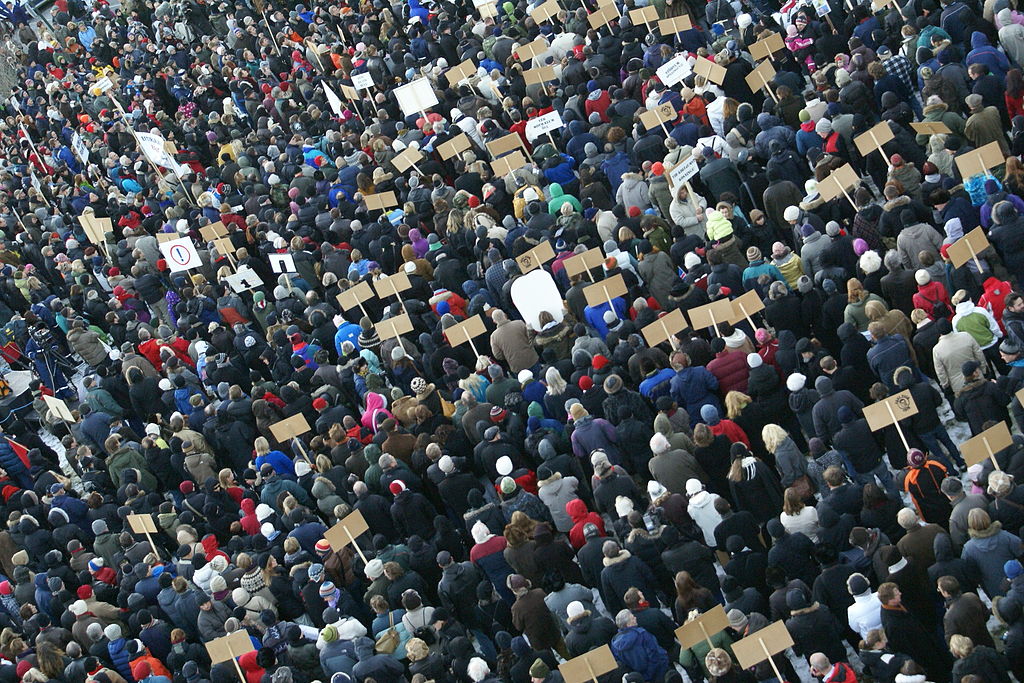
© OddurBen / CC BY SA 3.0

The thing that strikes me most about the present and—say—the last ten years in global society—is just how angry everyone is. Political leaders, commerce figures, populations, press, civil society, religion… everywhere you turn, they are increasingly angry.

Generously deliberative disagreement has virtually disappeared, as has the witty form of “debate-banter” that once graced the airwaves regularly between public intellectuals. Conversations in which friends hash out their differences in verbal and evidentiary sparring have given way to immediate friendship breaks—this person can’t in good conscience be friends with a “bigot” while the other won’t countenance a minute longer in the company of a someone that wants to “destroy civilization” and so on.

The opinion columns of the news press and the endless writing of the editorial and magazine press are filled not with questions and points of reflection but with strident answers and desperate calls to panic and to action. Everyone, on all sides, private and public alike, declares repeatedly a state of emergency.

Candidates for office, already elected officials, captains of industry, activists and volunteers, voting factions, and indeed entire voting populations are all hated by other voting factions and entire voting populations.

Everyone is strident. Social trust and charity have broken down. Sometimes, say on Facebook or in polite company, anger masquerades as so much high-mindedness, but hardly anyone is fooled; such high-mindedness only too obviously serves as cover for deep resentment with the unenlightned; it is invariably aggrieved virtue-signaling for present company rather than moral munificence.

It is an ethos of taking-to-the-streets, of judgment, of endless protest and self-justification. The question is which came first, the activism or the indignant angst? For surely both are now universal forces in a way that is historically unusual at the aggregate micro level. It begins to seem as if the whole place is gradually becoming a powerkeg of afflicted atoms on all sides.

Archives »

May 2026
April 2026
March 2026
February 2026
January 2026
December 2025
July 2025
May 2025
April 2025
February 2025
January 2025
December 2024
October 2024
September 2024
August 2024
July 2024
June 2024
May 2024
April 2024
March 2024
February 2024
January 2024
December 2023
November 2023
October 2023
September 2023
May 2023
April 2023
March 2023
January 2023
December 2022
November 2022
August 2022
June 2022
May 2022
April 2022
March 2022
January 2022
December 2021
November 2021
September 2021
April 2021
March 2021
February 2021
January 2021
December 2020
November 2020
October 2020
September 2020
August 2020
July 2020
June 2020
May 2020
April 2020
March 2020
February 2020
January 2020
December 2019
November 2019
October 2019
September 2019
August 2019
July 2019
May 2019
April 2019
March 2019
February 2019
January 2019
December 2018
November 2018
October 2018
September 2018
August 2018
July 2018
June 2018
May 2018
April 2018
March 2018
February 2018
January 2018
December 2017
November 2017
October 2017
September 2017
August 2017
July 2017
June 2017
May 2017
April 2017
March 2017
February 2017
January 2017
December 2016
November 2016
October 2016
September 2016
August 2016
July 2016
June 2016
May 2016
April 2016
March 2016
February 2016
January 2016
December 2015
June 2015
February 2015
January 2015
December 2014
October 2014
September 2014
August 2014
July 2014
June 2014
May 2014
April 2014
March 2014
February 2014
January 2014
December 2013
November 2013
September 2013
August 2013
July 2013
June 2013
May 2013
April 2013
March 2013
December 2012
November 2012
October 2012
August 2012
July 2012
June 2012
May 2012
March 2012
December 2011
October 2011
September 2011
August 2011
July 2011
June 2011
May 2011
April 2011
March 2011
February 2011
December 2010
November 2010
October 2010
September 2010
August 2010
July 2010
June 2010
May 2010
April 2010
March 2010
February 2010
January 2010
December 2009
November 2009
October 2009
September 2009
August 2009
July 2009
June 2009
May 2009
April 2009
March 2009
February 2009
January 2009
December 2008
November 2008
October 2008
September 2008
August 2008
July 2008
June 2008
May 2008
April 2008
March 2008
February 2008
January 2008
December 2007
November 2007
October 2007
September 2007
August 2007
July 2007
June 2007
May 2007
April 2007
March 2007
February 2007
January 2007
December 2006
November 2006
October 2006
September 2006
August 2006
July 2006
June 2006
May 2006
April 2006
March 2006
February 2006
January 2006
December 2005
November 2005
October 2005
September 2005
August 2005
July 2005
June 2005
May 2005
April 2005
March 2005
February 2005
January 2005
December 2004
August 2004
July 2004
June 2004
May 2004
April 2004
March 2004
February 2004
January 2004
December 2003
November 2003
October 2003
September 2003
August 2003
July 2003
June 2003
April 2003
March 2003
February 2003
January 2003
December 2002
November 2002
October 2002
September 2002
August 2002
May 2002
April 2002
March 2002
February 2002
January 2002
December 2001
November 2001
October 2001
September 2001
July 2001
June 2001
May 2001
April 2001
March 2001
February 2001
January 2001
December 2000
November 2000
October 2000
September 2000
August 2000
July 2000
June 2000
May 2000
April 2000
March 2000
February 2000
January 2000
December 1999
November 1999