蕭
耀
倫
a
r
o
6
e
d
g
2
l
p
a
n

a
r
o
n
h
s
i
a
o
w
a
s
h
e
r
e


Simple bit of not-particularly-original irony that I sometimes reflect on, and have recently as well.

The worst people I’ve known over the course of my life invariably thought they were fundamentally good people and justified in everything they did.

The best people I’ve known over the course of my have have spent a lot of time wondering whether they were fundamentally bad people and whether anything that they did could be justified.

It’s trite, but it’s funny how that works. It’s a truism for a reason.

Tomorrow it all starts back up again.

Work. School. Everyday life. Everything.


© Aron Hsiao / 2015

Looking back, I think this year’s break was particularly important for me. It’s been a very long two years. The two previous holiday seasons, everything was tense, up in the air, in a state of crisis. This one was more… peaceful. A chance to reflect, read some books, work out some thoughts.

I’m not particularly eager to hop back on the treadmill. January, in particular, is going to be a bear. And the return of everyday life means the return of everyday worries, things that you don’t necessarily worry about during the holiday season: responsibilities, bills, debts, careers and career stability, and so on. At times, the days ahead are going to be hell. I have no illusions. It is not a happy or easy period of life, and there is no getting around that.

But at the same time, I do feel as though this is to be a new beginning, the real start of the next phase of life. There is a part of me that is looking forward to what is to come, looking forward to seeing what I can make of things now that I am just me, unencumbered (I had chosen other words here, but they were too colorful).

— § —

The question about my work future remains at the front of my mind.

What are the things that I can do with the skills and qualifications that I have? In which direction should I climb? Is there, after all, a realistic possibility of some sort of career in the academy? If not, what happens after my current post?

I’ve never had to think about questions like this before. I’ve always been self-employed, until the last several years. I’ve always had multiple contracts ongoing, so that if one went, things would be tight, but income would still come in. And as one gig faded, another would take its place.

Now, there’s just one thing, one company, one relationship. And I know that nothing is forever. It’s a scary prospect. I blame my ex-wife for putting so much angry pressure on me for so many years to leave my previous work lifestyle behind. But behind it is, and I need to figure out where to go from here.

What to develop. What to pursue.

— § —

I’ve used the holiday season in part to rebuild my data life and data infrastructure to some extent. Given how I work and have worked (and I don’t mean at any one particular job, but in general, at the level of “work in my life”) for decades, gaining back some tools for collecting and organizing my thoughts, plans, and projects was step one.

Some people (say, me, but I know there are others) literally don’t know what they think until they get it all outside of themselves and look at it. Extroverts do this sort of thing through conversation with other people. Introverts do it by endlessly making, remaking, extending, mixing, and reading their own notes. Notes are a link to the self, and the self is the center of the universe when it comes to being able to function in society and to grow.

I’ve done a lot of introspection this year, and a lot of “personal growth” reading and thinking.

It’s time now to move beyond that and act in the world.

I was watching a video of Camille Paglia the other day, speaking to a group of students in the U.K. and taking some of their questions. Something that she said struck me. Our options for identity and social embeddedness in the current social milieu are so constrained that our sphere of self has grown ever smaller, so small that there is almost nothing left but the body itself to be “us, ourselves.” And so we spend endless time adorning it, enhancing it, modifying it, and reflecting on it (c.f. race, gender, sexuality, fitness, fashion, and so on).

(Okay, so I wasn’t as struck as I’m suggesting. I’d come to the same conclusion on my own.)

The corollary to this point, in any case, is that to escape the isolation and lack of transcendence that inheres in an “I am my body and nothing more” life, one must make a conscious effort to “self” (participate, observe, identify, connect, relate, act, engage, brand, etc.) beyond the body. In short, one must take risks and act in the world, in relation to other things, other places, other people, to ideas, to the social fabric, to the community.

I am arriving at that stage now. I’ve had my moment to turn inward, to think. That was 2016, almost in its entirety.

Now I have my conclusions. Some things about me have been recalled from the past. Other things about me have changed or been changed. Now I own it and then move beyond “my self,” “my space,” and “my life” in terms of how I spend my time.

— § —

On the notion of change, I should address the questions that have resulted from my declaring myself to be (a couple of posts ago) a “conservative.”

I didn’t mean this in exactly the way it was taken. My politics haven’t changed all that much, though some positions and basic values have been clarified. But with this clarification resulting from my introspection and new experiences, in concert with the clarifications that could not help but result from the recent election season, I realized that I had been uncertain of a lot of things for a very long time.

First, “conservative” here is not the same thing as “movement conservative,” “Republican,” “Trumpite,” or anything of the sort. I am referring more properly to a strand of thought that is not well represented in any of our parties right now. It’s more Yale than Heritage Foundation, more highbrow rag than Tea Party screed. It is a values position, rather than a policy position. It is an embrace of the very concepts of virtue, truth, prudence, and high-mindedness.


© Aron Hsiao / 2004

The reason for my “conversion” is not so much a change in ideas as it is a realization that while neither side of the aisle in American life embraces or exemplifies these things right now, the institutional American left and the academy are actually very must against them, not as moral propositions, but as possibilities. That is to say that there is an (ideological, in my opinion) insistence that these things simply do not exist in reality and are rather constructions (though not necessarily cynical or conspiratorial ones) to instate and ensure the dominance of certain biocultural groups (caucasians, males) or classes (the bourgeoisie).

Though I agree with more of the Marxist literature than most Americans and have spent many years grappling joyously with the implications (which are important) of postmodernism and post-structuralism, I find the idea that there is no such thing as objective virtue, objective truth, virtuous prudence, or worthwhile high-mindedness…. to be empirically false, and the arguments against them to be largely ahistorical. I find separate the following three ideas: that in modernity, society has rejected grand historical and existential metanarratives; that as a normative proposition, it is right, proper, and useful to reject such metanarratives; and that all such metanarratives are not merely ideological, but by virtue of their being metanarratives, self-evidently false and objectionable.

I agree with the first point as a historical matter and find this to be one of the most interesting and research-worthy facets of postmodernism, as it will surely have (and already has had) serious implications for human life and progress in the future. The other two, however, I categorically reject. Neither are all grand historical metanarratives false simply by virtue of being such, nor is the right course of action in all cases to reject them out of hand on precisely those grounds.

Instead, as with all things, what matters is discernment—judgment and discretion employed by virtuous, prudential, truth-seeking minds to determine which metanarratives have to go or are to be snickered at in retrospect, and which are to inspire, guide, and lead us—not toward a better future, for surely this doesn’t properly exist and never has, at the metaphysical and/or existential levels, but toward well-lived lives of meaning and rectitude.

So.

When you think these things: virtue, truth, prudence, the importance of high culture, the silliness of race, gender, and identity politics, the wrongheadedness of postmodernism—not itself as a now canonized literature in its entirety, but rather as the aggregate thought of many of its adherents, who seem to be sloppy thinkers that unwittingly allow the slippage of language to be mirrored in the slippage of thought—as well as the utter vacuity and even deplorability of the moral reasoning that it has produced (safe spaces, language-as-violence, and so on)… When you think these things, you cannot claim to be a person of the left.

Well, you can, but it is not clear communication; it is not something that can be understood without extended exposition. It is like using the word “orange” to refer to an apple, saying afterward that “I can always explain it to others in detail so that they understand what I mean, and I am willing to do this, so important is it to me to call the one thing the other.”

No. I have no particular attachment to any “side” in American political milieux so I will instead adopt cultural norms, as I believe to be prudent, and say that if most people today had an extended political conversation with me, they’d think I was a nutty brand of conservative that happily reads Marx and Gramsci and Adorno, but was absolutely, positively neither “liberal” nor “progressive,” though in the ’90s the same public would have clearly said the opposite.

So I accept what is (another talent that is long-lost on the left) and, in the interest of communicating clearly, now call myself a “conservative*” (asterisk important) henceforth. And I will continue to happily read and comment and interact and become involved locally on both sides of the aisle.

— § —

And now it’s time to go to bed. As always, it’ll take a moment to adjust to the unique context that is a fresh January, particularly after long weeks of being able to think and read until very late, then to sleep in until the same.

Night, world.

Oh, and Camille Paglia and Rod Dreher have become important voices to contend with, for me. That also indicates something significant along the lines outlined above.

Yes, anyway. Night.

Since the general transition to mobile computing, in which I was helplessly swept along like everyone else, there’s been a kind of hole in my personal knowledge life.

Notekeeping has disappeared. Plain text files created on the command line are out. The simple, powerful notes applications from the early generations of mobile devices—those found in Newton OS, Palm OS, and Windows CE—seem to have no equivalents these days.

Everyone is hung up on Evernote, which is okay so far as cloud synchronization goes, but which has one of the worst user interfaces for personal knowledge management ever created.

For a while I used DevonThink, which is very powerful and reasonably good, but unfortunately DevonThink is tied to the ’90s. It is hopelessl non-mobile, and its creators and much of its community have an ideological commitment to the avoidance of cloud services and the support of non-Apple platforms. This makes it a non-starter for anyone using Android—not to mention that it’s a pretty heavy wagon to pull just for the same functionality that Palm OS notes used to provide.

— § —


© Aron Hsiao / 2015

Anatomy of a good notes app in 2016:

  • Plain-text friendly and highly readable (Evernote fails)
  • Ability to elegantly and rapidly attach, view, and search other data formats
  • High-density index views showing as many titles as possible on-screen at once; very little white space (Evernote fails)
  • Ability to see at all times which category is currently selected, whether at index or at edit (Evernote fails)
  • Ability to swtich categories with two gestures max and zero changes to screen layout in the process (Evernote fails)
  • Ability to import and export standard plain-text formats both easily and with structure and metadata preserved (Evernote fails)
  • Cloud synchronization supporting Mac OS, Windows, Linux, iOS, and Android (DevonThink fails)
  • Tagging in addition to categories
  • Ability to capture and attach images directly to note as it is created

Every now and then I spend time looking around for an app that’ll do this. Basically Newton OS notes, Palm OS notes, or Windows CE Phatware notes but with cloud sync, multiplatform support, and image support (Newton actually had this, way back in the day, even if it didn’t have a built-in camera).

I never find what I’m looking for. Then I spend several days trying to convince myself either to settle for Evernote (and crap usability that will essentially lead to non-use on my part) or Devonthink (and a heavy anchoring to my Mac OS desktop that will essentially lead to non-use on my part). Then, I realize that I’ve been over all of this before, and I give up.

— § —

Today I realized that the best solution at the moment, and one that comes very, very close in all respects, has been staring me in the face for a while now—only I didn’t realize it because of the way the application is marketed.

It’s Diaro. It’s marketed as a personal diary, rather than as a notes application, but it actually meets or nearly meets every one of the criteria outlined above.

Add to that the fact that it’s a high-quality application with very good visual design and UX and it’s a pretty big winner for such a little product from a little company. What’s it missing? Well, basically, native desktop clients and support for data beyond plain text.

That last omission is almost a deal-breaker, but the fact is that Evernote isn’t even close to hitting the mark; it essentially relies on cloud sync to make up for every one of its other myriad shortcomings. DevonThink is also missing just one thing, but it’s a doozie—multiplatform support—that excludes anyone and everyone that uses non-Apple devices along with Apple computers (i.e. me).

My only worry with Diaro is that it’s developed and supported by a small, private company—meaning that its cloud sync and web application components are being held up by some fairly weak scaffolding and institutional staying power. But the fact that import/export is so incredibly easy and happens in open, industry-standard formats means that if it does go under, a structured data dump can be done in a matter of minutes.

So I’m actually switching my everyday note-taking over to Diaro. It sounds nuts, but that’s only because marketing is a powerful thing.

If the Diaro developer has any sense, they’ll wake up to the fact that they have an Evernote-killer on their hands and will quickly move to implement support for attaching data in other formats. At that point, I’ll happily pay the Evernote subscription fee that I’ve long paid to the developer of Diaro instead—and even be willing to pay two or three times as much.

So I’ve just spent hours down the rabbit hole.

All of this blog maintenance inspired me to go and take a look at some of the old codebases I mentioned a couple of posts ago. Believe it or not, most of them are still online at one host or another, though nowadays thanks to redirects, they are in many cases not visible to the outside world.

But they are there. In fact, even the Drupal 6.x Academe database—my naive-and-also-inspired megadatabase-and-blog from my early Ph.D. days—is still there. And it runs. And I remembered my login. And all of that data (most of which was my own research notes and process, and never appeared on the public blog view) is still there. It’s an amazing application and it makes me tempted once again to redevelop it for the current version of Drupal and begin to use it again, because DevonThink isn’t cloud-friendly (no mobile phone access, for example) and Evernote is too limited.

Some notes on my rabbit hole evening:

  • People have often made fun of me for keeping virtually everything digital all of these years, even if it meant lots of data work to keep transitioning to new applications or platforms with metadata intact, and so on. But going over it all tonight, I’m glad once again that I have.
  • Because there are 25 years of data at issue, it’s scattered. Some of my data is basically stored as files in a filesystem tree—my old Linux /home account files—that continues to live on my live storage to this day. Other data is in DevonThink. Other data is in Evernote. Other data is in WordPress on a host. Other data is in Drupal on a host. Other data is in various cloud apps. I’m in better shape than a lot of people with respect to retention and access of old material, but a project to clean and consolidate is needed badly—some things are at risk right now of being lost if host(s) or service(s) go down or applications become obsolete enough not to run.
  • My Drupal application was developed over the course of about two weeks in 2009, and it is superb. I remember the development mania fondly, but logging in and looking around it now, I’m floored by how useful and powerful it is. Speed is an issue (it’s PHP, after all, on a shared host), but at the same time, it’s closer to the life-database application that I want than anything else I’ve come across. I don’t know what to do with that knowlede.
  • The Drupal application is also filled with old files from the Ph.D. days—lots of graphs, diagrams, illustrations, and research data, for example. I need to get together a plan to migrate all of that back down from the shared host. Right now I don’t think a lot of it exists anywhere else. I could just do an FTP grab for the files, but that would lose a lot of the context and metadata linking it all together. Hmmmmmmm…
  • I spent some time reading back through hundreds of diary entries as well, scattered around multiple locations. No, not web diary or blog entries. Yes, I actually have even more stuff that I’ve written on an ongoing basis, navel-gazing about my life, that isn’t for public consumption. That’s how incurable I am when it comes to continuously typing and using words.
  • Circling back to the question of value—it was far more than merely informative to go back through old diaries and notes. A significant portion of the hours I’ve just spent was in reading through these.

© Aron Hsiao / 2016

Obviously there is much data hygiene work to be done in the future, and obviously I should get a move on as tech is moving as rapidly as ever.

But I want to leave that behind for the moment and focus on the last point in the list above.

— § —

I don’t know if this is true for everyone, but for me, a diary is an essential thing. This blog is one. My personal diary files are another. I tend to forget how essential they are for long periods of time, but the muscle memory in my fingers and the evolution-descended force of human habit keep me typing, week after week, month after month, and year after year.

Every now and then, a night like tonight happens, and I go back through all of that material and notice it. And read it. When this happens, I become enlightened. And edified.

See, I don’t know myself all that well. I like to think I do, but a self is a kind of an “out of sight, out of mind” thing. You can’t possibly remember all the things you’ve done, felt, thought, wanted, dreamed up, and so on over the years. There’s just too much going on this week, every week.

Hell, there’s too much going on today, every day.

Anything beyond seven to ten days back tends to get lost for me unless it’s pretty earth shaking. And then the thrusts of the present come to inform my general conception of the past—my past—and myself in it, on an ongoing basis.

That’s bad, because it basically means that I lose track of myself—or that my picture of who I’ve been (and thus, who I am now at the end of the path that led me here)—tends to be inaccurate.

Diaries are a corrective for this problem. A massive one. And, in fact, an easy one. Some things I’ve discovered tonight that I wouldn’t have had front-of-mind otherwise, and in many cases didn’t remember:

  • I was sad about being in an unhappy marriage all the way back in 2010, and writing myself encouraging notes about keeping life moving ahead, being strong, and working to try to make it better. But it’s clear that I was pretty miserable pretty often.
  • A lot of the problems that I spend ruminating on here on this blog, and in the late hours after an average workday, are problems that I’ve thought about before—and in many cases, problems I’ve already solved before.
  • Aside from solutions to problems, the old material is also full of wisdom that a former self had and the present self wouldn’t, but for access to said former self by way of this material. Brilliant ways to frame difficulties, important quotes, important decisions, the results of extended bouts of thinking-things-through that seriously shortcut paths that I’m having to confront now, and so on. So much is there, and it’s so helpful—yet I’d be clueless about any of it if I hadn’t saved it.
  • I’m pretty damned brilliant and I’ve done pretty damned brilliant stuff. Maybe it’s not too late for me after all. Maybe, if I play my cards right, it never will be—but I have to get started once again on the daily practice of being basically brilliant. Use it or lose it. I’m happy with that, because now I realize the degree to which I’ve already been thinking that I’d lost it, or the degree to which I’d forgotten that I ever had it to begin with.

There’s more, but I’ll stop. Point being, saving old data and thoughts is fucking fabulous. It is worth every last minute that I’ve put into the process over the years.

And it inspires me. And it motivates me.

This year is going to be a good year, I think.

Meanwhile, there are also some pretty significant data hygiene tasks to attend to. New year’s resolutions one and two, amongst several (that I expect) to come:

  1. Embark upon and successfully conclude a comprehensive data hygiene, organization, and consolidation project over the course of the year so that this stuff doesn’t get lost and becomes easier to navigate through and to access.
  2. Either find or build another “everything system” for my data. If Evernote and DevonThink aren’t it, maybe I’m back to building relational databases with Drupal and MySQL. We’ll see. But want something like that again. It makes me hungry.

As for now, it’s time for bed. But my advice to the young (who no doubt read this blog in droves in ways that somehow can’t be tracked by Google Analytics):

Diary. And save your scraps—notes, quotes, fragments, and musings. Do it every day. Maybe more than that. Seriously. You’ll thank yourself someday.

I have to admit that working and also updating the blog for 2017 was not exactly the way I’d imagined spending New Year’s Day. It was really all spur of the moment and dictated by circumstances.

Still, I’m very pleased with the way that this all turned out. Styling has been lightened up and I’m particularly happy with large screen and/or retina mobile landscape modes now, which are much more readable and reasonable than they used to be.

Thing is, now it’s 7:12 pm and I’m tired as hell, like I need to go to bed already. But if I go to bed now, I’ll no doubt wake up at 3:00 am.

Decisions, decisions.

— § —

My subscription to the Chronicle of Higher Education is coming up for renewal. And I won’t be renewing it. Already long lapsed are my memberships in the Association for Computing Machinery and American Sociological Association.

This makes me sad.

It’s a bit like dying.

So I’m just going to take a moment here to reflect on my little website.

It was just before the end of 1999 that personal events caused me to start keeping a “web diary” online as a way of coping with my life.

I’d had a “home page” before that hosted some ISP or other’s servers, back in the days before anyone registered their own domain name. It had, however, been mostly static content.


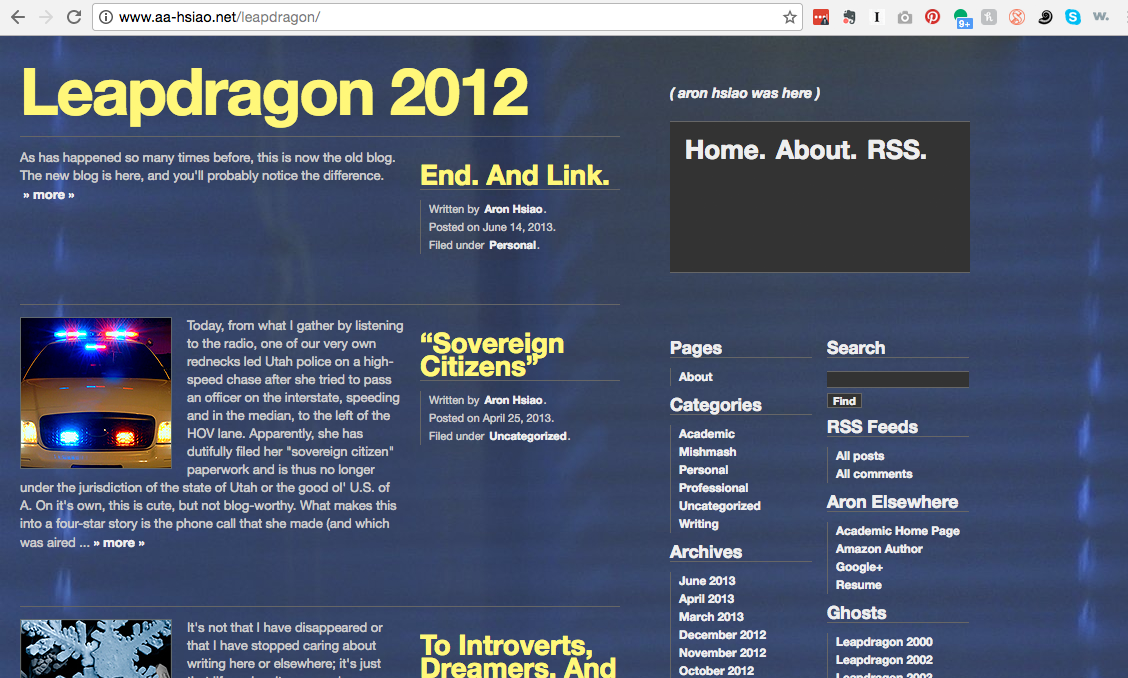
Old incarnations of Leapdragon.net from 1999, 2000, 2002, 2003, 2005, 2010, and 2012. © Aron Hsiao

The first incarnation of my “web diary” was a static .html file that I edited with Emacs and pushed up to the server with FTP.

Sometime in 2000, I decided that it would be easier if I scripted things, so I created a “diary” command (just a bash script) that started an Emacs instance saving to a temporary file, took whatever was saved in it and wrapped it in some HTML, prepended and postpended that HTML with a header, previous entries, and a footer, and then pushed the resulting file(s) up to the FTP server without my intervention. Over the next couple of years, I added some navigation to my scripts and they got more and more intricate.

By 2002 I was getting bored with the previous appearance, so I rewrote the scripts (which dumped hard-coded HTML into a flat HTML file) entirely and stuck the result on a new path at the domain I’d purchased. That gave me three versions of my “web diary,” the original, manual, flat-file version that I’d stopped maintaining, the 2000 version, and the 2002 version. I’d inadvertently started the habit of blogging, and inadvertently also started the tradition of updating the appearance of my blog for each new year. By 2004, after years of typing “diary” at my Linux command line to open a new Emacs instance and pound out some thoughts, I ventured into the CMS world with Graymatter, which was perl-based.

Then came Drupal in 2007, and with it a massive overbuilding (sometimes my skills get ahead of any intelligence) of a recklessly huge and complex database—visitors in public saw on the front-end anything tagged with “blog,” and on the backend there was a comprehensive, cross-referenced, cross-linked repository of quotes, calendars, contacts, dates, notes, ongoing papers and projects (with version management!), other publications from journal articles to books to magazine articles, in full-scan, all of their citations, etc. It was meant to be my ultimate for-everything, for-ever academic-and-personal-and-blogging-platform to house All Of My Data Forever And Ever More, and to enable me to write my dissertation and become a Master Of The Universe Academic with data always at my fingertips. It was my secret weapon. At one point I started to dabble in machine learning to try to make it smart enough to tell me things about what was in it.

It was, of course, too big and ridiculous to maintain, and a significant diversion from my life. It had, in fact, taken over my life. It worked well for a while, but the entire premise was bad (if you spend all of your time inputting everything you do, find, and think into a massive Drupal database, and keeping it up, it may seem pretty and advanced, but it leaves you little time to actually live or do other work). Once I realized this, I thought maybe I’d had it and would quit. But… I didn’t. (The data from that couple of years is the only data partially missing from the seventeen-plus years of posts on the right, because my tagging system—from public to private in multiple levels, with many, many different kinds of content, from draft papers to quotes to “ideas” to theoretical fragments to blog posts to articles—makes combing through all of that and trying to squeeze it all back into a blog impossible. I doubt whether any of it will ever be online again. I have a database backup, but… I doubt I’ll ever bother to pull it back into a database and try to decipher it again. It is a little, closed, mysterious universe of knowledge and papers all its own now, sealed off from reality and destined to crash at some point—that will likely be noticed by no one—into nonexistence.)

WordPress came in 2010. I simply tossed away all of the superstructure and returned to what I’d done at the beginning: keeping a web diary. Finally, early last year, I took all of the data from all of the URLs and CMSes, dumped the data, cleaned it up, and imported it all into WordPress for a single, consolidated database. This one, with all of the posts that are here.

Now I’m in the middle of year seventeen, and I’ve just updated the appearance for 2017. First day of the year. It all continues, after all this time.

Yes, this space is pointless. It’s often unreadable. It has virtually no audience. It’s bad for my career and just a little bit narcissistic. And now I’m neither a snarling twenty-something pirate swashbuckling my way through bars nor a climbing young Ph.D. candidate hoping to hit the academic bigtime. I’m just a dad, living in Provo, working a day job, living a very boring life.

But at the same time, this here blog is the most edifying thing I’ve done in my life. Academics are now over for me, apparently. Which means that this is the lone remaining ongoing project that has anything near this level of personal longevity and history in my life. And I love it.

For all its pointlessness, and for all the embarrassment that I’m sure at times it ought to cause me, I love it. Now that I no longer live in NYC, no longer hang out in the halls of academia, no longer head an intact nuclear family, etc.—this is home. It’s my little home on the web, where all of my foibles and idiosyncracies going back to my twenties can keep me company and remind me both of how stupid and how smart I’ve been over the years, and of all the things I’ve done and places I’ve gone and people I’ve known.

Through undergrad, grad school the first time around, Ph.D. school—through Salt Lake City and Chicago and Los Angeles and Portland and New York and Provo, through every serious relationship and every major job I’ve ever had, through marriage, parenthood, and divorce, through seven books, thousands of articles, and multiple personal and academic projects and publications, this has been the one daily constant in my life.

Here’s to you, Aron’s Web Diary. Seventeen years and counting. Happy new year!

Well, that’s a little bit better for large displays, at least.

I don’t suppose I’ll actually get the entire thing restyled, so this will have to do for now. Probably a few more tweaks as I discover issues. It’s responsive in the same way that a bowl of spaghetti is responsive—messy, but theoretically adaptable to different containers if you can avoid a lot of spillage.

In any case, it’s about 80 percent of the way done for 2017.

Meanwhile, it’s time to start going back through old posts and adding images in again. Life gets in the way and I stop adding images—which is a problem because the wall of text just isn’t interesting enough without them. The images are a fig leave over the vacuousness of the place. Gotta get the fig leaf back.

Archives »

September 2026
August 2026
July 2026
May 2026
April 2026
March 2026
February 2026
January 2026
December 2025
July 2025
May 2025
April 2025
February 2025
January 2025
December 2024
October 2024
September 2024
August 2024
July 2024
June 2024
May 2024
April 2024
March 2024
February 2024
January 2024
December 2023
November 2023
October 2023
September 2023
May 2023
April 2023
March 2023
January 2023
December 2022
November 2022
August 2022
June 2022
May 2022
April 2022
March 2022
January 2022
December 2021
November 2021
September 2021
April 2021
March 2021
February 2021
January 2021
December 2020
November 2020
October 2020
September 2020
August 2020
July 2020
June 2020
May 2020
April 2020
March 2020
February 2020
January 2020
December 2019
November 2019
October 2019
September 2019
August 2019
July 2019
May 2019
April 2019
March 2019
February 2019
January 2019
December 2018
November 2018
October 2018
September 2018
August 2018
July 2018
June 2018
May 2018
April 2018
March 2018
February 2018
January 2018
December 2017
November 2017
October 2017
September 2017
August 2017
July 2017
June 2017
May 2017
April 2017
March 2017
February 2017
January 2017
December 2016
November 2016
October 2016
September 2016
August 2016
July 2016
June 2016
May 2016
April 2016
March 2016
February 2016
January 2016
December 2015
June 2015
February 2015
January 2015
December 2014
October 2014
September 2014
August 2014
July 2014
June 2014
May 2014
April 2014
March 2014
February 2014
January 2014
December 2013
November 2013
September 2013
August 2013
July 2013
June 2013
May 2013
April 2013
March 2013
December 2012
November 2012
October 2012
August 2012
July 2012
June 2012
May 2012
March 2012
December 2011
October 2011
September 2011
August 2011
July 2011
June 2011
May 2011
April 2011
March 2011
February 2011
December 2010
November 2010
October 2010
September 2010
August 2010
July 2010
June 2010
May 2010
April 2010
March 2010
February 2010
January 2010
December 2009
November 2009
October 2009
September 2009
August 2009
July 2009
June 2009
May 2009
April 2009
March 2009
February 2009
January 2009
December 2008
November 2008
October 2008
September 2008
August 2008
July 2008
June 2008
May 2008
April 2008
March 2008
February 2008
January 2008
December 2007
November 2007
October 2007
September 2007
August 2007
July 2007
June 2007
May 2007
April 2007
March 2007
February 2007
January 2007
December 2006
November 2006
October 2006
September 2006
August 2006
July 2006
June 2006
May 2006
April 2006
March 2006
February 2006
January 2006
December 2005
November 2005
October 2005
September 2005
August 2005
July 2005
June 2005
May 2005
April 2005
March 2005
February 2005
January 2005
December 2004
August 2004
July 2004
June 2004
May 2004
April 2004
March 2004
February 2004
January 2004
December 2003
November 2003
October 2003
September 2003
August 2003
July 2003
June 2003
April 2003
March 2003
February 2003
January 2003
December 2002
November 2002
October 2002
September 2002
August 2002
May 2002
April 2002
March 2002
February 2002
January 2002
December 2001
November 2001
October 2001
September 2001
July 2001
June 2001
May 2001
April 2001
March 2001
February 2001
January 2001
December 2000
November 2000
October 2000
September 2000
August 2000
July 2000
June 2000
May 2000
April 2000
March 2000
February 2000
January 2000
December 1999
November 1999