
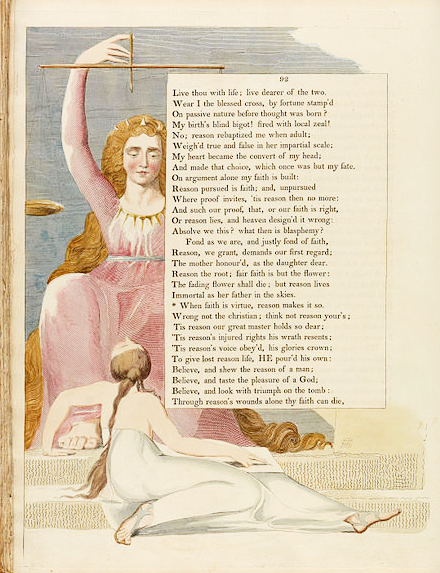
Public Domain
The discourse on faith and reason is often framed as one in which the two stand in opposition to one another, with adherents to each view attributing the ills of the present to the other.
I have two thoughts on this point, one minor and trite, and the other somewhat more important and less often discussed.
- There is no necessary opposition between the two. The apparent opposition is a matter of the specificity of faith(s) at issue; there is no need for faith as such to contradict reason if in fact the faith is structured in such a way as to be compatible with it. For example, the common “physics and the laws of the universe are precisely how God chose to get things done” puts faith and reason rather in the same box. The conflict at issue, rather, is between particular faiths that are unable for reasons of culture, tradition, and belief to arrive even at detente with reason, much less a position of reasoned embrace. It is thus not faith but in fact the unwarranted belief in things that simply, demonstrably, and empirically are not so that stands in contradiction to reason.
- I think that framing the nature of social ills in terms of a debate about the relative culpabilities of faith and reason misses the point entirely. I’ll explain now.
— § —
What people seem not to understand is that for a quarter, or even perhaps at this point a half a century, both faith and reason are anathema.
Sometime in the 20th century it became a cultural truism that faith was both anachronistic and false. Reason stepped in, as was expected, to fill the void—and it did so for some time, similarly asserting the importance of the collective, of social norms, of the discernment of positive and negative behavior, and so on. Even if it arrived via a different train on different tracks, the destination was largely the same—a healthy society, even if this wasn’t always achieved in practice.
By the time of the culture wars in the late midcentury period, however, the ground under reason was shifting. Now reason, too, was suspect. It had given us Vietnam, Marxism and capitalism, and the stifling uniformity of American suburbia. By the turn of the century, reason was also considered to be obviously anachronistic and false—the source of nuclear waste, climate change, the profit-driven drug industry, pesticides in agricultural production, and so on.
The dominant cultural milieu of the moment is not one in which some line up for reason and others line up for faith and all enter the melee.
It is one in which the average individual understands that he is subversive, less worthy of respect, and apart from the normative group if he or she embraces either reason or faith. God and science must both be disowned and made fun of.
This is the source of our troubles now. Both god and science made the case for the collective, and had something to say about the relationship between the individual and society. But now both are anathema, and anything that makes arguments about self and its relation to society is claimed to be either one or the other (faith or reason) and is rejected as unwarranted and unacceptable on the basis that faith and reason are both inherently unjust and unjustifiable.
— § —
This is another way to approach the fact of postmodernism—the rejection of the “grand narrative” as such (of which God and science are the two most important)—which leaves us, as a matter of conscious choice, with nothing.
“Nothing,” goes the argument, ultimately, “can be argued to be true. To do so is to embrace either a false God or a false science.” Nothing remains, as a normative matter, but the id and the ego. I have in the past written about the collapse of epistemology, but what I probably should have written was that it has been rejected. Not “how do we know” but rather “it is wrong to know.”
That single moral principle alone—that it is wrong to know—is the one thing taken on faith. The rest becomes the fulfillment of drives. Hence activism, terrorism, granola-ism, and a million other isms. They are all variants of the same impulse to reject anything outside the self as grand narrative, most notably God and science.
It’s not a “secular” age that we’re living in. It’s an “interior” age, in which there is no such thing as the world or as society, and in which all of normatively acceptable knowledge must originate and be justified only by the individual self.